Payment Systems in Malaysia
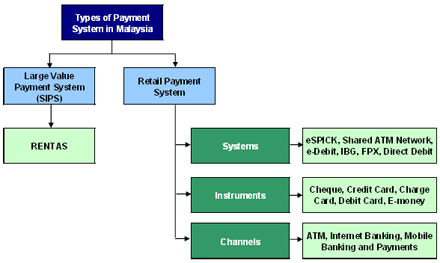
Malaysia's Payment System
Systemically Important Payment System (SIPS)
A systemically important payment system or large value payment system (LVPS) typically processes high-value and
time-critical payments. It is an essential payment system to ensure the smooth functioning of the economy, financial
system and financial markets, and its failure could trigger disruptions or transmit shocks within the economy and
the financial market, both at the domestic and potentially at the cross-border level. RENTAS is the only LVPS for
Malaysia and it is operated under Real Time Gross Settlement (RTGS) basis.
Real Time Electronics Transfer of Funds and Securities (RENTAS)
RENTAS was implemented in July 1999 with the objective to improve the overall efficiency of the large value payment
system, particularly in respect of reducing interbank settlement risk. It enables the transfer and settlement of
high value interbank funds and scripless securities transactions. There are two types of transactions handled by
RENTAS namely Interbank Funds Transfer System (IFTS) and Scripless Securities Transfer System (SSTS). The following
transactions can be performed by RENTAS members via the system:
- Interbank funds transfer;
- Cash withdrawals from Bank Negara Malaysia;
- Statutory reserve adjustment;
- Money market settlement;
- Ringgit leg of foreign exchange; and
- Scripless securities transfer.
Currently, there are 69 participants in RENTAS, which comprise of commercial banks, Islamic banks, investment banks,
Development Financial Institutions as well as institutions that are active players in the money market or capital
market.
There is no limit set for the transfer of funds between members. However, the minimum transaction amount for third
party payments (payments that originate from a non-RENTAS member or beneficiary) is set at RM10,000. This limit does
not apply for payments to and from Bank Negara Malaysia and government agencies.
In November 2006, Bank Negara Malaysia in collaboration with the Hong Kong Monetary Authority, implemented the
Payment versus Payment (PvP) infrastructure for settling interbank ringgit-US dollar trade transactions. The direct
link between RENTAS in Malaysia for the settlement of ringgit and the USD CHATS system in Hong Kong for the
settlement of US dollar, enable the simultaneous settlement of ringgit in Malaysia and US dollar in Hong Kong during
Malaysian business hours, thus eliminating foreign exchange (FX) settlement risk for ringgit and US dollar FX
transactions.
As part of the Bank's continue effort in improving and enhancing the capability of RENTAS to support cross-border
payments and settlements, the onshore multi-currency funds and securities settlement facility was launched for
renmimbi (RMB) settlements in March 2012. The new RENTAS facility will enhance the efficiency of RMB trade
settlements for Malaysian corporate by reducing costs and ensuring finality of settlements.
See also: Press release on Renmimbi
Settlement Services in RENTAS
Retail Payment System
In general, the retail payments in Malaysia can be divided into three - Retail Payment Systems, Retail Payment
Instruments and Retail Payment Channels.
Types of retail payment systems
National Electronic Cheque Information Clearing System (eSPICK)
Bank Negara Malaysia had in 2008 implemented the National Electronic Cheque Information Clearing System
(eSPICK) to replace the previous Sistem Penjelasan Imej Cek Kebangsaan (SPICK) cheque clearing system.
eSPICK was fully rolled out nationwide in July 2009.
The implementation of eSPICK was part of the Bank's effort in enhancing the efficiency of the payment
system. The Bank together with the banking industry have migrated the cheque processing phase from
physically sending cheques for clearing at the clearing centres into a fully image-based cheque clearing
process.
Customers and businesses will benefit from the speedier and more efficient cheque clearing system,
especially in the timing of the availability of funds from the deposit of outstation cheques. Under the
eSPICK, customers will receive funds from the cheques deposited during business hours on the next
business day, compared to between 2 to 8 business days previously.
Shared ATM Network (SAN)
Shared ATM Network (SAN) enables bank customers to access their funds from any of the participating
banks’ automated teller machine (ATMs). There are currently two shared ATM networks, namely, the
MEPS SAN and HOUSe. The MEPS SAN is operated by the Malaysian Electronic Payment System Sdn Bhd
(MEPS), which services offered includes cross-border cash withdrawal, interbank ATM funds transfer
(IBTF), interbank mobile prepaid top-up and credit card and loan repayment. As at to date, 14
domestic banks and 7 foreign banks have participated the MEPS SAN.
Link to MEPS Website
HOUSe
Established in 2006, HOUSe is owned by four locally-incorporated foreign banks, namely, HSBC Bank, OCBC
Bank, Standard Chartered Bank and UOB Bank. Services offered includes cash withdrawal and balance
enquiry.
Direct Debit
Direct debit, which is operated by MyClear Sdn Bhd, is an interbank collection service for regular and
recurring payments enabling automated collection directly from a customer’s bank account at multiple
banks with a single authorization.
Link to MyClear Website
Financial Process Exchange
Financial Process Exchange (FPX) is an Internet-based multi-bank payment platform that leverages on the
Internet banking services of banking institutions to offer online payment for electronic commerce
(e-commerce) transactions.
Link to MyClear Website
Types of retail payment instruments
Cheques
A cheque is a paper based payment instrument. It is a form of written order directing a bank to pay money
to the beneficiary. Based on the market practices in Malaysia, a cheque is generally valid for six
months after the date of issue. The use of cheques has traditionally dominated Malaysian non-cash
payments. Despite the development of other payment instruments, cheques remain an important form of
non-cash payments.
Credit Cards
A credit credit card enables its holder to buy goods and services with a credit line given by credit card
issuer and the amount will be settled at a later date. Cardholders are billed on a monthly basis and
cardholders would have to bear finance charges (interest) on the outstanding amount if payment is not
made by the due date. For a hefty fee, a credit card can also be used for cash advances at Automated
Teller Machines (ATMs) and at respective credit card issuers' counters. Examples of credit card brands
are Visa, MasterCard and JCB. A tiered pricing structure for credit cards was implemented in July 2008
with the objectives to promote prudent financial management and inculcate good financial discipline
amongst credit card users. The tiered pricing structure is based on the following tiers:
Tier 1 - Maximum of 15% per annum (those who promptly settle their minimum payment due for 12
consecutive months);
Tier 2 - Maximum of 17% per annum (those who promptly settle their minimum payment amount due for at
least 10 months in a 12-month cycle); and
Tier 3 - Maximum of 18% per annum. The Bank had in 2011 introduced new credit card guidelines to
inculcate sound financial and debt management among credit card users. The new measures covers
eligibility criteria, prudential requirements for non-bank issuers, risk management requirements,
pricing and consumer protection.
See also: Press release on
New Measures on Credit Cards to Promote Prudent Financial Management and Responsible Business
Practices
Charge Cards
The functionality of a charge card is similar to a credit card. However, charge card holders must settle
their outstanding amount in full by the due date every month. Since charge cards are often associated
with prestige, the fees are generally higher than credit cards. This is compensated by the differences
in terms of benefits, with charge cards generally offering more privileges. Its popularity has dropped
in Malaysia.
Debit Cards
A debit card is a payment card where the transaction amount is deducted directly from the cardholder's
bank account upon authorisation. Cardholders can manage their finances more effectively and need not
worry about late payment penalties, finance charges, and snowballing card debts. There is also no income
requirement to qualify for one. In Malaysia, anyone having a bank account with a domestic bank and has
an ATM card can make payments using the card at any merchants displaying the Bankcard logo, as it
doubles as a debit card. There are also international brand debit cards under the VISA and MasterCard
brands as well as cards with both international debit and domestic PIN-based ATM applications.
E-money
E-money is a payment instrument that contains monetary value that has been paid in advance by the user.
E-money users can use their e-money to purchase goods and services from merchants. When users pay using
e-money, the amount will be automatically deducted from their e-money balance. E-money comes in
different forms and can be broadly categorised as card-based and network-based, which are currently
accessible via the internet and mobile phones.
Link to MyClear Website
Types of retail payment channels
Internet Banking
Internet banking provides a fast and convenient way of performing common banking transactions, such as
transferring funds from the customers' savings account to their current account, or even to a third
party's account. Through Internet banking, customers could also repay their loan and card outstanding
amount, make payments to relevant parties, such as utility bills, assessment tax, and others. If you
have a computer with Internet access, a web browser and a registered account for Internet banking
service from your banking institution, you'll be able to do your banking and payments from the comforts
of your home, office, or virtually anywhere else in the world.
All internet banking transactions are secured to ensure that users' information could not be stolen.
However, users should also practise precaution, which include keeping their Login ID, password or PIN
confidential; checking that they have logged into the right website; logging-off at the end of each
session and clearing the memory cache and history after logging out from the website; and protecting
their personal computer from viruses and malicious programmes by installing an up-to-date hackers
firewall and a reputable anti-virus program.
Link to list of offering Banks
Mobile Banking
Mobile banking is similar to Internet banking in that it provides a fast and convenient way of performing
common banking transactions. To enjoy the benefits of mobile banking, all you need is a mobile phone
that is equipped with the features required by your bank that provides this service. Once you obtained a
registered account for mobile banking from your banking institution, you'll be able to do your banking
transactions from anywhere that has your mobile telecommunication network coverage.
All mobile banking transactions are secured to ensure that users' information could not be stolen.
However, users should also practise precaution, which includes not leaving their mobile phone that is
linked to their account unattended to; keeping their PIN confidential; and never reply to any SMS
claiming to be from their bank or asking for their banking details.
In early 2012, three major banks collaborated with two major mobile network operators had offered a new
mobile banking and payment services, MyMobile. With MyMobile, registered users can perform various
banking transactions such as fund transfer, bill payments, mobile prepaid reload and credit card
repayment at any time and from any location. The advantages of MyMobile are among other, its ability to
support fund transfers using the mobile phone numbers of beneficiaries instead of bank account numbers,
and it is accessible through all types of phones.
See also:
- MyClear Website on MyMobile
- List of offering Banks
Mobile Payment
Mobile payment allows you to make payments to selected merchants by using your mobile phones. Bill
payments and purchase of goods and services are among the cashless transactions that can be made. To
enjoy the benefits of mobile payments, you have to register and open an account with mobile payment
service providers. Non-bank mobile payment services are provided using an e-money account. For more
information on e-money, please refer to the e-money section.
