

iTEKAD Entrepreneurship: Empowering low-income microentrepreneurs
iTEKAD Entrepreneurship aims to assist low-income microentrepreneurs to strengthen their financial management and business acumen towards generating sustainable income. By leveraging on social finance instruments, each programme combines 1) seed capital to start or sustain their business; 2) access to microfinance; and 3) structured financial and business training.

For more information, please read our feature article, iTEKAD: An Ecosystem Approach in Scaling Up Social Finance in BNM’s Annual Report 2023.
(as of end-December 2025)
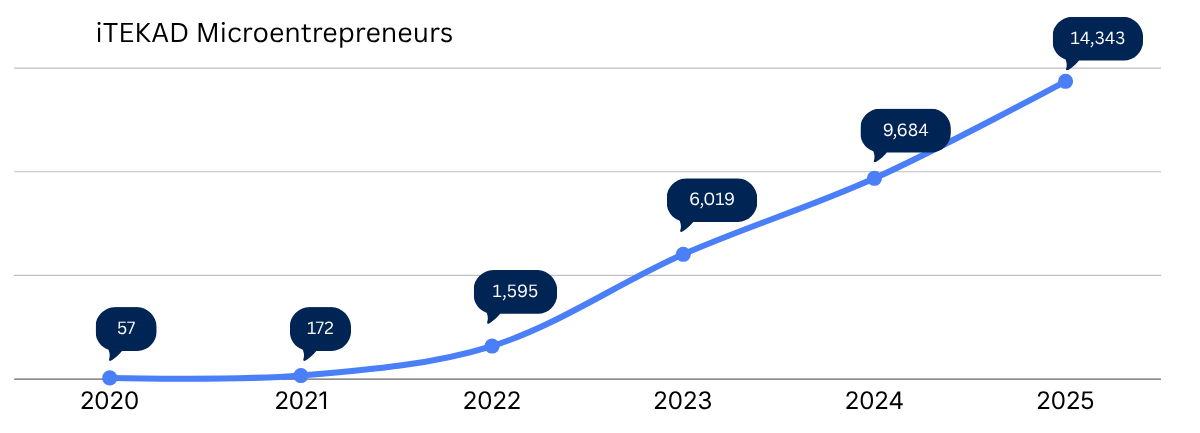
Financial institutions participating in iTEKAD Entrepreneurship









AmBank Islamic
| Programme name | AmBank Islamic’s iTEKAD Programme |
|---|---|
| Objective | Provide grant, technical and entrepreneurship training at early stage of their business, with support on digital infrastructure |
| Funding features | Returned zakat and access to microfinancing facility |
| Value-added propositions | Zakat-funded grants with support for enhancement of business digital capability |
| Target segment | Asnaf entrepreneurs |
| Implementation partners |
|

Bank Islam
| Programme name | iTEKAD BangKIT Microfinance | iTEKAD Maju Microfinance |
|---|---|---|
| Objective | Provide benevolent loans / Qard financing for business start-up and expansion | Microfinancing for working capital and seed capital on needs-basis |
| Funding features | Donations-funded microfinancing facility | Returned zakat and microfinancing facility |
| Value-added propositions | Benevolent loan for business start-up and business expansion | Zakat-funded purchase of business equipment for business expansion |
| Target segment | Microentrepreneurs who are ineligible for ordinary banking financing facilities | B40 and asnaf microentrepreneurs |
| Implementation partners |
|
|

Bank Muamalat
| Programme name | iTEKAD Mahabbah |
|---|---|
| Objective | Provide benevolent loans / Qard financing to support microbusiness owners or gig economy workers from selected business sectors (as agreed with funders) |
| Funding features | Returned zakat and microfinancing facility |
| Value-added propositions | Benevolent loan to support businesses in sectors including food and beverages, and the gig economy |
| Target segment | Microentrepreneurs in the F&B sector and gig economy |
| Implementation partners |
|

CIMB Islamic Bank
| Programme name | iTEKAD CIMB Islamic Rider Entrepreneur Asnaf Programme | Melon Manis Terengganu (MMT) Graduate Agropreneur Programme | Program Keusahawanan (PK) CIMB Islamic – Taylor’s |
|---|---|---|---|
| Objective | Provide participants with employment opportunities as food delivery riders to establish stable income, paired with entrepreneurial training | Develop viable and resilient agropreneurs in Terengganu, specifically for those from poor families | Provide financial assistance and entrepreneurship training to selected microentrepreneurs from the asnaf and B40 segments, who are looking at growing their small/micro businesses |
| Funding features | CSR grant, cash waqf, zakat fund and microfinancing facility | Charity/zakat fund and microfinancing facility | Charity/zakat fund and microfinancing facility |
| Value-added propositions | CSR- and waqf-funded motorcycles and entrepreneurship training programme for beneficiaries, with prospective opportunity for business financing if required | Agropreneur Training and Farm Managers Program (FMP), with certification on production of hybrid melons by UniSZA alongside entrepeneurship training | |
| Target segment | Individuals from B40 and asnaf categories | Low-income agropreneurs from low-income families in Terengganu | Individuals from B40 and asnaf categories |
| Implementation partners |
|
|
|

Public Islamic Bank
| Programme name | Public Islamic iTEKAD Micro Entrepreneurs Development Programme | Public Islamic Kelestarian Ekonomi Asnaf Zakat Melalui Penternakan Itik Penelur (KELIP) iTEKAD Programme |
|---|---|---|
| Objective | Provide support to microentrepreneurs at early stage of their business through entrepreneurship training tailored to respective business sector | Empower asnaf participants by providing technical training on poultry farming and entrepreneurship |
| Funding features | Returned zakat and access to microfinancing facility | Returned zakat and access to microfinancing facility |
| Value-added propositions | Entrepreneurship development through funding support and training in digital marketing and operations | Comprehensive support in both technical poultry farming and business development, ensuring participants have the necessary tools to gain a sustainable income stream from duck egg farming |
| Target segment | Asnaf entrepreneurs | Asnaf participants |
| Implementation partners |
|
Universiti Malaysia Pahang Al-Sultan Abdullah (UMPSA) |

RHB Islamic Bank
| Programme name | BEST-BYOB (B40 Empowerment Strategy – Be Your Own Boss) |
|---|---|
| Objective | Provide support to start pre-franchise business through structured training, business matching and financial assistance |
| Funding features | Returned zakat and access to SME financing facility |
| Value-added propositions | Zakat-funded grants and/or benevolent loans for start-up of franchise business |
| Target segment | Asnaf venturing in pre-franchise business |
| Implementation partners | Perbadanan Nasional Berhad (PERNAS) |

Bank Simpanan Nasional
| Programme name | BSN MulaNiaga |
|---|---|
| Objective | Facilitate gradual growth of participants towards being bankable by providing training, coaching and funding in tranches |
| Funding features | Returned zakat with graduation to microfinancing facility |
| Value-added propositions | Zakat-funded grants and/or graduation to microfinancing for business expansion |
| Target segment | Asnaf and graduated asnaf, who may not be eligible for zakat assistance nor ordinary banking financing faciilities |
| Implementation partners |
|

Bank Rakyat
| Programme name | Bank Rakyat UNIpreneur | RAKYATpreneur | Rakyatpreneur B40 |
|---|---|---|---|
| Objective | Provide support to student entrepreneur through coaching, mentoring and monitoring | Provide support to microentrepreneurs at early stage of their business through coaching, mentoring and monitoring | Provide support to microentrepreneurs through coaching, mentoring and monitoring |
| Funding features | Returned zakat and access to microfinancing facility | MOF grant and access to microfinancing facility | |
| Value-added propositions | Zakat-funded and/or MOF grants for expansion of new business | ||
| Target segment | University students entrepreneurs from asnaf/B40 background | Asnaf microentrepreneurs with at least 3 months business operation | Non-asnaf B40 entrepreneurs |
| Implementation partners |
25 universities nationwide:
|
|
|

Agrobank
| Programme name | Structured Community Development Programme for Cash Crop and Sumber Kekayaan Baru | Agroiltizam |
|---|---|---|
| Objective |
|
Assist B40 and asnaf groups who are either existing microentrepreneurs or individuals who aspire to be microentrepreneurs in the agriculture sector, to start and maintain their businesses. |
| Funding features | Diverse social finance funds (zakat, zakat wakalah, etc.) and access to microfinancing facility | Social finance funds (fund guarantees) and access to microfinancing facility |
| Value-added propositions | Support in the form of agriculture inputs, equipment and land infrastructure, intended to support venture into agripreneurship and subsequent expansion post-incubator stage | Additional support for customers of Agrobank’s Agroiltizam Microfinancing and Agroiltizam Contract Financing |
| Target segment | Asnaf who are committed to become entrepreneurs and work on agricultural projects i.e. becoming an agripreneur | B40 or asnaf microentrepreneurs involved in agro-based and agriculture value chain business |
| Implementation partners |
|
|

SME Bank
| Programme name | SME Bank iTEKAD Ishraf |
|---|---|
| Objective | Provide training, medium-term coaching and seed capital as funding support |
| Funding features | Returned zakat, CSR contributions and access to microfinancing facility |
| Value-added propositions | Zakat- and/or CSR-funded grants for business start up or expansion |
| Target segment | Asnaf entrepreneurs |
| Implementation partners |
|

Maybank Islamic
| Programme name | Aspirasi Wanita | POD – Qard Hassan Social Financing Programme | Community Economic Development – Megapreneur Programme | Program Usahawan Belia Sejahtera | iTEKAD Emerging Micro-Entrepreneurship Programme |
|---|---|---|---|---|---|
| Objective | Empowering the economy for women in micro-enterprises and the gig economy, while embracing digital technology | Empowering the economy for underserved segments through a financial well-being platform and Qard-based microfinancing programme | Developing Asnaf participants’ entrepreneurial skills to generate additional income and improve their economic well-being | Empowering youth Asnaf entrepreneurs in Terengganu by providing training and support to encourage them to start and manage their own businesses successfully | Provide support to microentrepreneurs at early stage of their business by providing seed capital, mentorship and training, as well as access to affordable and tailored financing. |
| Funding features | Zakat and access to microfinancing facilities | MIB’s Ikhwan Charity Fund and access to microfinancing facilities | Zakat and access to microfinancing facilities | Zakat and access to microfinancing facilities | MIB’s Ikhwan Charity fund and access to microfinancing facilities |
| Value-added propositions | Funding and training to support start-up of business or gig career | Funding and training to support start-up of business or gig career | Funding and training to support start-up of business | Funding and training to support start-up and existing business | Funding and training to support start up business |
| Target segment | Aspiring microentrepreneurs or gig workers from asnaf categories | Youth, single mothers and B40 segment who needs funds for their micro-businesses, as well as gig workers | Asnaf entrepreneurs from Peninsular Malaysia | Asnaf entrepreneurs (faqir miskin) from Terengganu | Aspiring microentrepreneurs with at least 1 year business operation in Johor |
| Implementation partners |
|
Pod Capital Sdn Bhd | ZL Empire Sdn Bhd | Yayasan Pembangunan Usahawan Terengganu (YPU) | POD Capital Sdn. Bhd. |

Hong Leong Islamic Bank
| Programme name | Women Excellence | SURI Youth Empowerment Program | Central Kitchen |
|---|---|---|---|
| Objective | Provide funding and training to marginalised low-income groups towards venturing into entrepreneurship in different economic activities | Facilitate microentrepreneurs’ access to a central kitchen, business equipment and necessary industry training & accreditation | |
| Funding features | HLISB Special Fund for Projects with subsequent access to financing facility | Zakat wakalah and purification fund with subsequent access to financing facility | Capital funding by the NCIA appointed Implementation Partner with subsequent access to financing facility |
| Value-added propositions | Special training to help women entrepreneurs grow their revenue and create job opportunities | Funding and living skill of sewing to targeted B40 youths / single mothers | Facilitating access to a central kitchen, business equipment and necessary industry training and accreditation |
| Target segment | Women entrepreneurs | Underprivileged / B40 youths from Langkawi, specifically targeting single mothers | F&B entrepreneurs |
| Implementation partners | MADCash | SURI |
|

Affin Islamic Bank
| Programme name | iTEKAD PERWIRA-i |
|---|---|
| Objective | To support retired Malaysian Armed Forces personnel in harnessing skills and productivity to generate sustainable income streams via entrepreneurship |
| Funding features | Zakat funds and microfinancing facilities |
| Value-added propositions | Funding and training to provide insights to the fundamentals of business management, digital economy and online marketing |
| Target segment | Retired Malaysian Armed Forces personnel |
| Implementation partners |
|
Association of Islamic Banking and Financial Institutions Malaysia (AIBIM)
| Programme name | myZakat – Program Transformasi Usahawan Asnaf |
|---|---|
| Objective | Provides comprehensive support for asnaf entrepreneurs, focusing on long-term business success and personal growth through seed capital, business equipment, structured training, mentoring, and access to microfinancing, going beyond short-term aid to enable lasting impact |
| Funding features | Zakat wakalah and access to microfinancing facilities |
| Value-added propositions | Pilot multibank* iTEKAD programme |
| Target segment | Asnaf entrepreneurs, particularly in commercial food production, and air-conditioning & electrical wiring services, based on the recommendations of the respective State Islamic Religious Councils (SIRCs), and tailored to the specific needs and demands of each location |
| Multibank participating banks |
|
| Implementation partners |
|
* Multibank iTEKAD programme: An iTEKAD programme involving more than one participating financial institution, collectively offering microfinancing to eligible iTEKAD programme participants, while also contributing to the programme’s seed capital or structured training components.

Alliance Islamic Bank
| Programme name | Alliance Islamic TEJA iTEKAD Programme |
|---|---|
| Objective | Provide support to microentrepreneurs at early stage of their business through entrepreneurship training tailored to respective business sector |
| Funding features | Social finance funds and access to microfinancing facility |
| Value-added propositions | Entrepreneurship development through funding support and training in digital marketing and operations |
| Target segment | B40 women in Sarawak comprising from former recipients of the Geran Permodalan Pemerkasaan Wanita Sarawak |
| Implementation partners |
|

AEON Bank
| Programme name | AEON Bank’s Growth Start Programme | Sustainable, Reliable, Income (SRI) Program |
|---|---|---|
| Objective | Provide support to microentrepreneurs at early stage of their business through entrepreneurship training tailored to respective business sector | Improve the socioeconomic well‑being of B40 mothers in Selangor by equipping them with practical tailoring skills, providing essential tailoring tools, and directly linking them to income‑generating opportunities upon programme completion. |
| Funding features | AEON Bank’s Sadaqah and Ujrah, with future access to microfinancing facilities (currently being developed) | AEON Bank’s CSR fund and microfinancing facilities |
| Value-added propositions | Open-door iTEKAD programme whereby participants are provided with entrepreneurship development through funding support and training in digital marketing and operations | Support through funding, technical skills and training in digital marketing and financial literacy. |
| Target segment | B40 women entrepreneurs | B40 mothers community in Selangor |
| Implementation partners |
MADCash Sdn Bhd |
|
Frequently Asked Questions on iTEKAD Entrepreneurship

- Capacity building – Participants receive training in financial and business management, as well as relevant technical know-how specific to their respective business sectors (e.g. sewing skills for tailors)
- Coaching and mentoring –Participants are closely guided by a mentor / peer groups to support business growth
- Value-adding support – Participants may be provided with opportunities to enhance their capabilities, such as adoption of digital technologies or by undertaking relevant certifications.
