Speeches & Interviews
Filter by year
Filter by speaker
Search title in Speeches
Filter by year
Filter by speaker
Keynote Address by Governor Abdul Rasheed Ghaffour
at the AVPN Global Conference 2025
Hong Kong | 10 September 2025
‘Catalysing Asia’s Finance for People and Planet’
We are now a quarter of the way into the Asian Century. The question is no longer whether Asia will grow, but how we will grow, and whether the prosperity we create will be one “without regret” – because with great growth, comes great responsibility.
Despite remarkable advances, prosperity across our region remains uneven. Hundreds of millions have entered the middle class, yet too many are still left behind in informal work, with limited access to finance or social protection.
At the same time, planetary pressures are mounting. Asia is the world’s growth engine and increasingly a major driver of global emissions. It is also where climate impacts are felt acutely. As advanced economies recalibrate their sustainability agendas, Asia cannot afford to slow down. In fact, this is our moment to accelerate – not to compete, but to ensure our vulnerabilities do not widen.
The paradox is clear. The same forces that are driving Asia’s rise could, if left unchecked, undermine its future. Yet even with these challenges, Asia has what it takes to build a prosperity that is inclusive and sustainable.
First, the world’s centre of economic gravity has already shifted east. It is expected to sit between India and China in less than 5 years[1] – decades earlier than once predicted by my fellow Malaysian, Professor Danny Quah[2]. Asia today already accounts for over 60% of global growth[3]. Intra-Asia trade now exceeds trade between Asia and the rest of the world, and is expected to grow by 400 billion US dollars annually in the coming years[4].
Second, we sit on a vast pool of long-term capital. Our region is associated with a high savings rate[5], state-run pension systems, sovereign wealth funds, and family-owned conglomerates. These have both the capacity and the mandate to think in decades, not quarters. In countries like Malaysia and Indonesia, the depth of Islamic finance adds a distinctive reservoir of patient, risk-sharing capital.
Third, behind this structural advantage lies a cultural one. In much of Asia, the self is understood through relationships and duties within a long-term, interdependent moral order. Here, tradition and social harmony matter more than individual autonomy. If aligned with today’s challenges, these cultural instincts – expressed through our capital structures – give Asia a unique advantage to mobilise capital for lasting prosperity without regret.
Within Asia’s story, ASEAN is becoming a central chapter. The Association of Southeast Asian Nations is emerging as a steady source of growth in an increasingly uncertain and multipolar world.
Today, ASEAN is already the world’s fifth-largest economy. Its combined GDP of more than 3.9 trillion US dollars[6], projected to exceed 5 trillion before 2030[7], will put it behind only the US, China, Germany by the end of the decade.
Underpinning this momentum is a growing population of 670 million people, with a median age of 30[8]. This decade, ASEAN is expected to add over 130 million middle-class consumers[9], and this is equivalent of creating a new Japan.
What is striking is not only the scale, but the resilience of growth. While not a straight line, GDP growth has averaged 4.8% for the past 2 decades[10] – through financial crises, pandemic and a shifting global order. This resilience is why ASEAN is at the heart of global supply chains, from agro-commodities to semiconductors, and natural resources to new frontiers in batteries.
This past year, as part of Malaysia’s chairmanship of ASEAN, I have seen unprecedented interest in the region. From Hanoi to Denpasar, leaders in business and government have been leaning in for greater regional integration. But beyond trade within ASEAN, there is growing interest for investment and strategic partnership with Southeast Asia. Rising risk premia in the West – amid the changing geopolitical landscape and new trade linkages – together with Southeast Asia’s growth trajectory, makes our markets increasingly attractive.
Here, there are immense opportunities for impactful investment. Take for instance electricity consumption per capita in ASEAN which, on average, is about 3,500 kilowatt hours[11] – far below the 6,000-kilowatt hour benchmark for a modern economy[12]. At the rate which ASEAN countries have been building power generation capabilities, it would take them between 21 and 327 years to reach this level of electrification, even if they relied on coal[13]. This is why the ASEAN Power Grid is a breakthrough and transformative – meeting rising demand and powering growth, while leapfrogging to cleaner, more connected energy systems.
Some markets in the region can serve as safe launchpads: they carry the same challenges common across ASEAN, but with the stability and financial depth to de-risk innovation. And Malaysia is certainly one of them.
But a frontier is only valuable if capital can flow and models can scale. To translate promise into investable reality, financial systems in Asia must get three things right.
First, we need to do better at structuring risks to mobilise capital at scale. Governments today are carrying heavy fiscal burdens, the highest in recorded history, exceeding 100 trillion US dollars[14]. Given the immensity of the sustainable development challenge we face, this finite fiscal space means public budgets alone cannot finance this transition that we need.
However, Asia today mobilises less blended finance for infrastructure than Africa[15]. This is not because the opportunities are lacking, but because risks are insufficiently priced and pipelines are under-prepared. But if we can present the region’s challenges not as unknowns but as quantified risks, we can unlock the vast pools of capital which is already sitting in Asia.
And here, Islamic finance offers a structural advantage, giving us ready-made infrastructure for risk-sharing. Sukuk tied to real assets, profit-and-loss partnerships, zakat and waqf as catalytic first loss – this is a financial architecture built for blended finance. In markets like Malaysia and Indonesia, where Islamic finance is mature, the foundations are ready. The question is, what might we build together on top of it?
The second imperative is to build platforms for inclusive productivity. Technology has allowed us to reach people once beyond the financial frontier. Innovations like well-interlinked payment systems, e-KYC and open data protocols are bringing in millions of people out of informal systems. Digitalisation and AI are helping us manage risk better, reducing funding costs and enabling more tailored services.
But inclusion must go beyond access and efficiency. Credit must flow into assets that build resilience and productivity, not just consumption. We already see sparks of this. In Malaysia, the iTEKAD programme (which in Malay means “I am determined”) is offering blended financial solutions to microentrepreneurs. These are de-risked by grants and seed capital – some of which is from zakat, a form of obligatory almsgiving in Islam used to support the poor and needy. iTEKAD also offers structured training on relevant business skills, and has improved well-being for more than 9,000 microentrepreneurs[16] that participated in the programme, dignifying them not only with increased revenue but also the ability to create jobs for others. Some who began at roadside stalls now serve international markets. Imagine if we could scale structures like this across Asia, promoting inclusive growth and lifting millions from survival to enterprise.
Third, we need to back ecosystems, not just one-off projects. In the 20th century, Asian governments famously employed industrial policy to pick winners. From steel to shipbuilding and microchips to K-pop, this approach produced miracles. But the sustainable development paradox we face today is too complex and capital-intensive for the state alone. What we now need is not so much industrial policy but industrial co-creation: where governments convene corporates, financiers, technologists and communities to co-design ecosystem solutions.
Malaysia is beginning to model this. The Climate Finance Innovation Lab (CFIL) is now open for business to prototype new financial solutions for climate and nature-related projects. The Greening Value Chain (GVC) initiative is aligning anchor corporates with their SME suppliers to decarbonise entire supply chains through financing and technical support. These are early signs of this new kind of industrial co-creation.
Ladies and gentlemen,
In closing, Asia has what it takes to address the immense challenges we face today. It is through platforms like the AVPN – where funders across all pools of capital converge with innovators and policymakers – that these strengths can be aligned and further amplified. It will be because we – here in in this room – chose to creatively deploy our abilities to build lasting prosperity which generations to come will look back on without regret. And with that, thank you very much for the invitation and your kind attention.
References
[1] Allianz Global Investors (2021, January 18). Asia Post Covid-19. Allianz Economic Research. https://www.allianz.com/en/economic_research/insights/publications/specials_fmo/2021_01_18_AsiaPostCovid19.html
[2] Quah, D. (2011). The global economy's shifting centre of gravity. Global Policy, 2(1), 3-9. https://doi.org/10.1111/j.1758-5899.2010.00066.x
[3] International Monetary Fund (2024, November). Regional economic outlook for Asia and Pacific: Resilient growth but higher risks. https://www.imf.org/en/Publications/REO/APAC/Issues/2024/10/31/regional-economic-outlook-for-asia-and-pacific-october-2024
[4] World Economic Forum (2025, January). How Asian markets will respond to changes in demand & trade. World Economic Forum. https://www.weforum.org/stories/2025/01/how-asian-markets-respond-changes-demand-and-trade/. According to this report, “Nearly 60% of Asia’s trade is now conducted with regional trade partners, up from 53% in 2000.” The WEF projects “that intra-regional trade will continue to rise 65%, or $400 billion per year by 2030.”
[5] Wong, C. (2024, July 4). Are Asians saving too little or too much? And what does this mean for insurance? Peak Re. https://www.peak-re.com/media/sbzlxdzo/are-asians-saving-too-little-or-too-much-and-what-does-this-mean-for-insurance-2.pdf
[6] World Bank (2024). GDP (current US$). World Development Indicators. https://data.worldbank.org/indicator/NY.GDP.MKTP.CD
[7] International Monetary Fund (2025). World Economic Outlook: GDP, current prices (NGDPD). https://www.imf.org/external/datamapper/NGDPD@WEO/OEMDC/ADVEC/WEOWORLD
[8] Database.Earth (2025). Median age in South-Eastern Asia. https://database.earth/population/south-eastern-asia/median-age
[9] SCB Thailand (2024). The rising of middle class in ASEAN. Siam Commercial Bank. https://www.scb.co.th/en/personal-banking/stories/business-maker/the-rising-of-middle-class-in-asean
[10] Yap, L. P., & Ramli, I. M. (Eds.) (2024, September). Services and investment liberalisation in ASEAN (ERIA Research Project Report FY2024 No. 18). Economic Research Institute for ASEAN and East Asia (ERIA). https://www.eria.org/uploads/Services-and-Investment-Liberalisation-in-ASEAN.pdf
[11] ASEAN Centre for Energy (2024, September). The 8th ASEAN Energy Outlook (AEO8): 2023–2050. ASEAN Centre for Energy. https://aseanenergy.org/the-8th-asean-energy-outlook/
[12] Wirjawan, G. (2024, March 14). The Paradox of Sustainability: A Critique of the Modern World's Approach to Sustainable Development. Shorenstein Asia-Pacific Research Center, Stanford University. https://aparc.fsi.stanford.edu/publication/paradox-sustainability
[13] Wirjawan, G. (2024, March 14). The Paradox of Sustainability: A Critique of the Modern World's Approach to Sustainable Development. Shorenstein Asia-Pacific Research Center, Stanford University. https://aparc.fsi.stanford.edu/publication/paradox-sustainability. These calculations exclude Brunei and Singapore, which have already reached the 6,000 kWh benchmark.
[14] UNCTAD (2024, June 25). Global public debt hits record $102 trillion in 2024, striking developing countries hardest. United Nations Conference on Trade and Development. https://unctad.org/news/global-public-debt-hit-record-102-trillion-2024-striking-developing-countries-hardest
[15] Convergence Blended Finance (2025). The State of Blended Finance 2025. Convergence.
[16] Bank Negara Malaysia (2025). iTEKAD initiative. https://www.bnm.gov.my/itekad accessed 4 September 2025
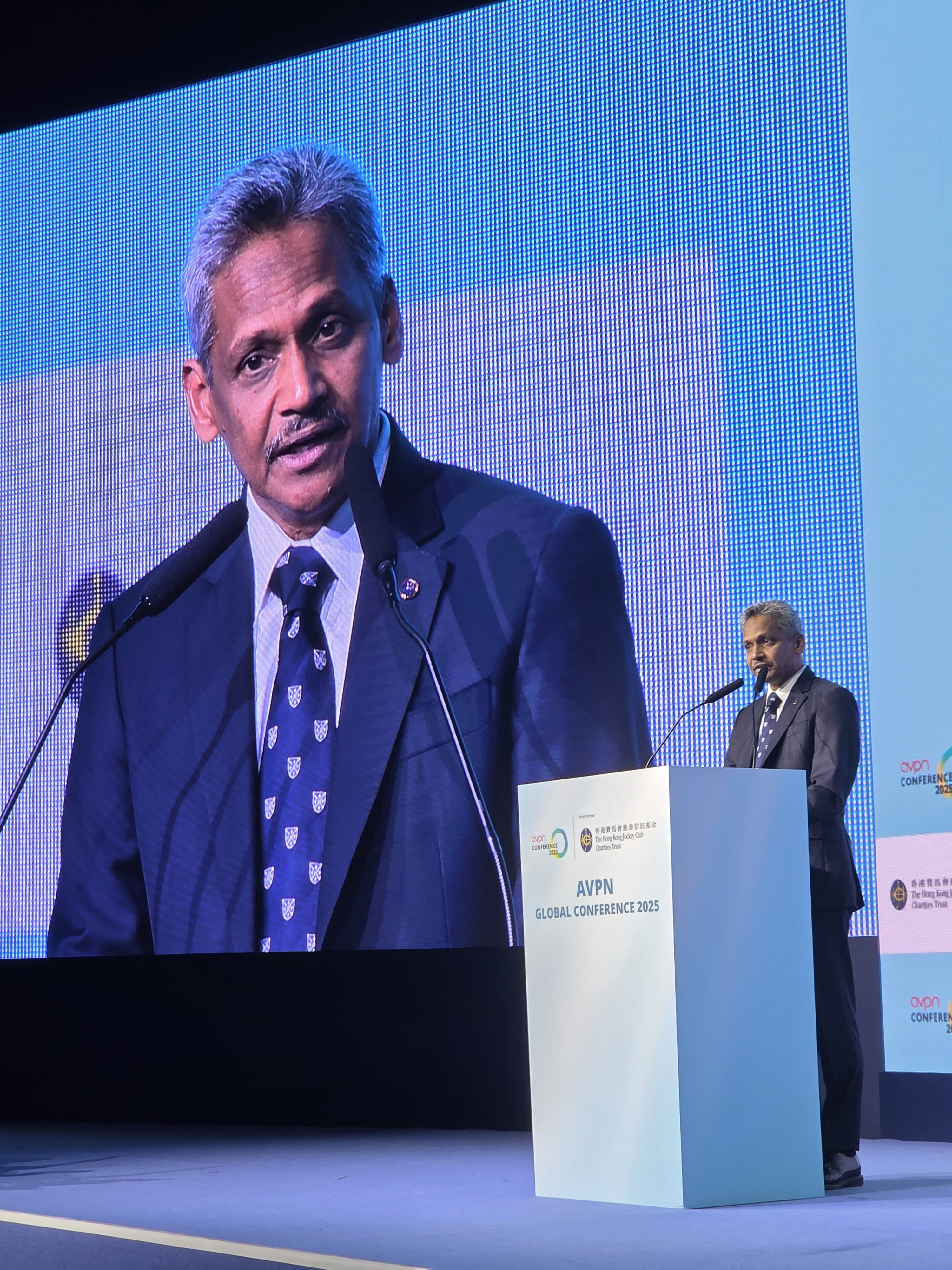
Dato’ Seri Abdul Rasheed Ghaffour, Governor of Bank Negara Malaysia, delivering his keynote address at the AVPN Global Conference 2025

